Ross Cameron’s video teaches a specific small‑cap day trading approach and how he turned it into over $1,000,000 in 51 trading days, focusing on risk, stock selection, entries, and scaling up.
1. Context, Results, and Big Picture
- Trader: Ross Cameron, full‑time day trader, founder/lead at Warrior Trading.
- Track record: Started with a $583.15 small account challenge in 2017; turned it into $100k in ~45 days, $335k by end of 2017, $800k+ by end of 2018, and over $1M profit by 2019; cumulative profits now exceed $12.5M and have been audited by a third‑party CPA.
- Challenge covered in this video: Make $1,000,000 as fast as possible in 2025; he reached that goal in 51 trading days.
- Recent performance: 51 consecutive green days for this challenge and a broader 76‑day green streak over the last nine months; only 7 red days over that period.
Key performance metrics (51‑day challenge)
| Metric | Value |
|---|---|
| Total trades | 936 trades |
| Accuracy | 71.4% |
| Avg gain per trade | $1,000 |
| Avg winner | $1,800 |
| Avg loser | $761 |
| Avg hold time (winners) | 3 minutes |
| Avg hold time (losers) | 2 minutes |
| Profit/loss ratio (approximate) | Close to 3:1 |
All metrics above are from his broker‑connected reporting software covering the 51 days.
2. Core Framework: Three Pillars of Profitability
Ross breaks profitable day trading into three core components.
- Accuracy
- Profit‑to‑loss ratio (R:R)
- Consistency
He argues that consistency is a byproduct of solid accuracy plus a favorable profit‑to‑loss ratio, executed with discipline.
2.1 Accuracy
- Definition: Percentage of trades that are green (profitable).
- Accuracy tends to improve with experience as traders better recognize valid setups vs. false breakouts.
- He stresses intuition/gut feel develops over time and is largely pattern recognition from experience.
Example from his stats:
- Accuracy: 71.4% over 936 trades.
2.2 Profit‑to‑Loss Ratio (R:R)
- He aims for at least 2:1 profit‑to‑loss on each trade.
- Concept: If you make $2 on winners and lose $1 on losers on average, you break even around 33% win rate; anything above that is profitable.
Break‑even logic examples (per trade):
- If you risk $1 to make $2 (2:1):
- Break‑even accuracy ≈ 33%.
- If you risk $1 to make $1 (1:1):
- Break‑even accuracy = 50%.
- If you risk $2 to make $1 (0.5:1):
- Break‑even accuracy ≈ 67%.
His actual numbers:
- Avg winner ≈ $1,800; avg loser ≈ $761 → better than 2:1, closer to 3:1.
- Given this ratio, he could be roughly break‑even even around 25–30% accuracy; at ~71%, he is deeply profitable.
2.3 Consistency
- Consistency = a stable equity curve with few big drawdowns.
- He attributes his string of green days to:
- A clear strategy.
- Very high discipline following rules (especially in the first trades of the day).
- Tight risk control (cutting losers quickly).
He stresses that profit is the output of a good system plus disciplined execution, not something you can improve directly by “trying to make more money.”
3. Why Most Beginners Lose
Ross identifies two main causes of failure among day traders.
3.1 Cause #1 – No Strategy (Shooting from the Hip)
- Many beginners trade:
- A bit of large caps, small caps, options, meme stocks, etc.
- Without a defined edge or repeatable setup.
- He notes this was common in the dot‑com bubble and the pandemic period: people made money on momentum and luck, then lost it once markets softened.
3.2 Cause #2 – No Discipline to Follow the Strategy
- The second group learns a strategy but doesn’t follow the rules:
- FOMO (fear of missing out).
- Revenge trading when frustrated.
- Trading too large after a loss.
- Ignoring max loss or entries/exits.
- Emotional hijack: after a loss, the amygdala (fight‑or‑flight center) takes over and logic disappears.
Ross’s own admission: Even with years of experience, he sometimes breaks his rules on a given day, usually when emotional (frustrated or fearful), which leads to poor trading decisions.
4. Risk Management: How He Thinks About Risk
Risk management is the first pillar of his strategy and is considered before everything else.
4.1 The Key Question Before Every Trade
Before entering, he asks: “How much am I risking on this trade?”
- He distinguishes between:
- Capital deployed (e.g., $100,000 position size).
- Actual risk (difference between entry price and planned stop, multiplied by share size).
He argues that this question separates traders from gamblers; gamblers focus only on potential profit and ignore risk.
4.2 Example: $100,000 Position But Only $7,500 Risk
He shows a candlestick chart of a stock that ran over 700% in a few days and describes a typical dip‑buy setup.
Setup assumptions:
- Stock had a strong move up, then pulled back (a “dip”).
- He identifies:
- Stop (max loss): Around $6.50 (low of pullback).
- Entry: Around $7.00 on the first candle to make a new high.
- Profit target: Retest of prior high around $8.00.
Per‑share risk and reward:
- Risk: $7.00 entry – $6.50 stop = $0.50 per share.
- Target: $8.00 – $7.00 entry = $1.00 per share.
- Profit‑to‑loss ratio: 2:1.
With 15,000 shares (~$100,000 position):
- Max loss = 15,000 × $0.50 = $7,500.
- Profit target = 15,000 × $1.00 = $15,000.
He emphasizes that although the position is over $100k, he is not risking $100k because he can sell anytime; the risk is limited by the stop distance and share size.
The same trade could be taken with 150 shares:
- Max loss ≈ $75; profit target ≈ $150.
Or 15 shares, 1,500 shares, etc. → the strategy scales down linearly.
4.3 Scaling and Diminishing Returns
He explains that you can’t scale a strategy up indefinitely due to liquidity limits.
- As share size increases, profits generally increase until a point, then:
- Slippage increases.
- Entries/exits move the market.
- You start to make less with even larger size.
He sketches this as:
- Profit rising with size to a sweet spot, then flattening and declining when size is too large.
Once you reach this peak for a given strategy, his view is you then add additional strategies to grow further instead of forcing more size into one setup.
4.4 Negative vs. Positive Feedback Loops
He describes two loops:
Negative feedback loop (typical beginner path):
- Low‑quality stocks → poor accuracy → big losers (poor R:R) → emotional trading → more rule‑breaking → worsening performance.
Positive feedback loop (goal):
- Focus on high‑quality stocks meeting clear criteria.
- Accuracy improves.
- Profit‑to‑loss ratio improves (fewer big mistakes).
- Consistency and profitability increase.
- Track record strengthens.
- Confidence grows, enabling larger size and more trades.
- Profitability rises further.
He says breaking the negative loop starts by strictly focusing on only the best stocks that meet his checklist.
5. Typical Beginner Mistake in Risk: Inverted R:R
Ross uses his early trading as an example of what not to do.
5.1 Inverted Profit‑to‑Loss Ratio
His early stats looked like this:
- Avg winners: 1 unit (e.g., 10 cents per share).
- Avg losers: 2 units (e.g., 20 cents per share).
That’s a 0.5:1 profit‑to‑loss ratio (losers are twice as large as winners).
- Required accuracy to break even ≈ 66%.
- His real accuracy at that time ≈ 50%.
- Result: He lost money even though he was right about half the time.
5.2 Psychology Behind That Pattern
Common behaviors that cause this pattern:
- Cutting winners too quickly: Fear that profit will disappear leads to selling immediately when green → small winners.
- Holding losers too long: Hoping bad trades will come back leads to delaying the exit → large losers.
He stresses that cutting losses fast and giving good trades enough room is necessary to flip this ratio.
6. Stock Selection: The “Right” Stocks
Ross treats stock selection as risk management: choosing strong stocks lowers the chance of unnecessary losses.
He has studied his trades for nearly a decade using analytics software and found clear patterns in where he makes the most money.
6.1 Five Core Criteria
He defines a “right stock” by five criteria.
- Pre‑market gap up of at least 2% (ideally 10%+) (HIGH DEMAND)
- The stock is already up in pre‑market (before the opening bell), at least 2%, but he prefers 10% or more.
- This shows strong early demand.
- Gaps up happen because of Breaking News.
- Five times relative volume (HIGH DEMAND)
- The stock’s volume on the day is at least 5× its 50‑day average volume.
- This indicates unusual interest and activity.
- Breaking news catalyst moving the stock higher (HIGH DEMAND)
- Some news event explains the volume and price spike:
- Earnings.
- FDA approval or clinical trial data.
- Company‑specific positive announcement.
- News drives the rate of change in price and volume.
- Some news event explains the volume and price spike:
- Price between $2 and $20
- He finds his best trades in this range.
- Rationale:
- Low enough for big percentage moves (blue chips rarely have large % moves)
- High enough to avoid some of the extremely low‑priced junk.
- Low float under 10 million shares (LOW SUPPLY)
- Float = shares available to be traded by the public.
- Under 10M means limited supply, which allows price to move rapidly when there is strong demand.
- Small floats can still have 100x volume vs the float, since traders end up buying selling buyying selling within a day = Huge imbalance between supply and demand
He notes that when a stock between $2–$20 has breaking news, 5× relative volume, is already gapping up, and has float under 10M, “that’s when things get exciting.”
6.2 Examples of Extreme Movers
He shows several examples of how powerful these setups can be:
- A stock that moved from around $2 to over $20 across two days (~1,000% gain) on news.
- Another stock that spiked 430% in one day with 300M shares of volume but a float under 1M; volume far exceeded float due to constant buying and selling.
He points out you don’t need the whole move; capturing small pieces (e.g., part of a 1,000% move) can make for a great day.
6.3 Why He Avoids Slow, Sideways Names (Example: Ford)
He demonstrates with Ford Motor Company (F):
- Ford trades tens of millions of shares (55M in his example) but:
- The price is basically sideways.
- He buys 1,000 shares and sells for a $5 loss; there’s no significant movement.
- Long‑term investors, mutual funds, and pension funds might buy/hold Ford, but day traders need volatility and range, which Ford lacks in a typical day.
He concludes day traders should prioritize moving stocks, not household names that barely move intraday.
7. The Role of Stock Scanners
Ross uses real‑time scanning software to find opportunities that meet his criteria.
7.1 Scanning Setup
- Platform: Day Trade Dash.
- He configures multiple scanners, each with its own filter set (e.g., momentum scanners, gappers, low float).
- The scanners search the entire market in real time for stocks that:
- Are up at least his target % (e.g., 10%+).
- Have 5× relative volume.
- Are between $2–$20.
- Have low floats.
When a ticker meets conditions, he gets an audio alert (“ding ding ding”), then pulls up the chart.
7.2 Typical Outcomes of Scanned Names
He shows his scanner list with floats like:
- 7M shares, 3M, 14M, 300k, 3M, 4M, 1M, etc.
- Notes that biggest percentage gainers with volume almost always have floats under 20M, often lower.
Once he identifies a candidate, he then waits for a familiar pattern on the chart (see next section) before entering.
8. Entry and Exit: The Bull Flag Pattern
After selecting the right stock, Ross further manages risk by only trading specific patterns on those stocks.
Use 1 minute candles.
8.1 Bull Flag Basics
Definition: A bull flag is a continuation pattern composed of an initial strong move up (flagpole) followed by a controlled pullback (flag). Apply on a stock that is actively squeezing up.
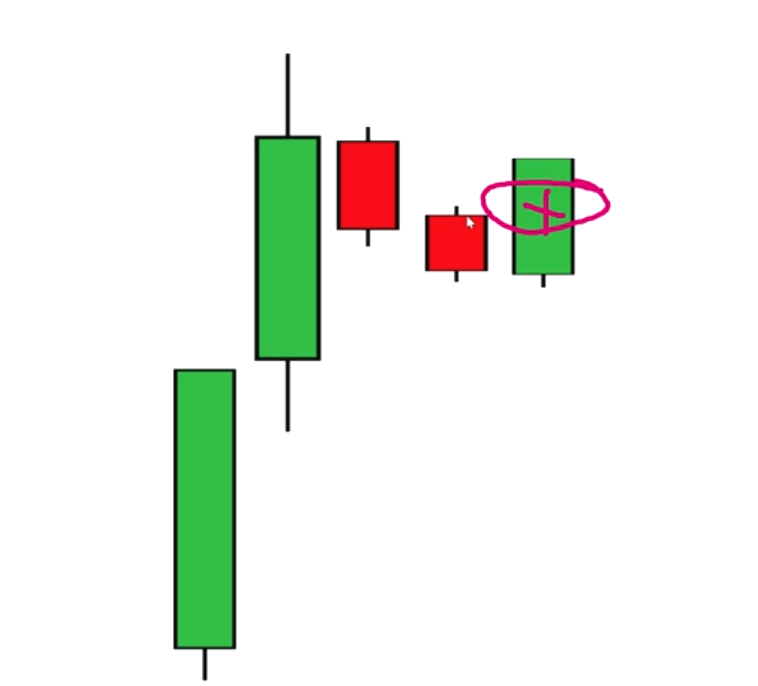
- Typically made of 5–7 candles:
- Strong green candle on breaking news and surge in volume.
- Stock pulls back with lighter volume as early longs take profits.
- Price stabilizes and retraces only part of the initial move.
- Entry is usually during first candle to break the high of the previous candle after the pullback.
- Set SL at bottom of previous candle, TP at 2x, or higher.
Psychology:
- Big move up on news = traders and algorithms pile in.
- Profit taking creates a temporary dip.
- As long as the pullback holds above a key level (often about 50% retracement), buyers step back in and push for a new high.
8.2 Entry and Stop in the Bull Flag
His preferred entry and stop rules:
- Entry: First candle to break above the high of the pullback range (first candle to make a new high).
- Stop: Low of the pullback (the recent swing low).
- Target: Retest of high of day or measured move higher.
This structure naturally creates a defined risk (between entry and stop) and potential reward (to previous high or above), often greater than 2:1.
8.3 Example With Numbers (Revisited)
Using the earlier number example:
- Pullback low: $6.50 → stop.
- Entry on first candle to make a new high: $7.00.
- High of day: $8.00 → target.
- Risk: $0.50/share; Reward: $1.00/share → 2:1 R:R.
He highlights that this structure applies whether you trade 15 shares or 15,000 shares; the pattern is scalable.
Position management and consistency
This is the later section you specifically wanted covered in full. It is one of the most important parts of the video because it shifts from setup selection to how the day is managed.
Main claim
The video argues that consistency comes largely from position management, especially how size is handled at the start of the day and after early results. The aim is to avoid starting with oversized losses that trigger emotional deterioration.
Hot market vs. cold market
The framework does not use the same aggression every day. When the market is hot, size and aggressiveness increase; when the market is cold, size is reduced and the trader should be quicker to stop.
| Market condition | Suggested behavior |
|---|---|
| Hot market | Trade more aggressively, increase size, press good setups harder. |
| Cold market | Reduce size, ease off, and be more willing to walk away. |
This is tied to the idea that identical share size on every trade is not optimal for a discretionary trader. Market quality changes, and size should adapt to that reality.
The “profit cushion” rule
The key consistency method in the video is the profit cushion. The idea is to start the day small, test conditions, and only scale up after building a cushion in realized profit.
The rule described is:
- Cap early size at one quarter of full position size until one quarter of the daily profit goal has been made.
- If that cushion is built, increase to full size.
- If the cushion is lost later, size back down or stop.
- If no trade appears for about 30 minutes, call it and stop trading.
A direct example is given using a $20,000 daily goal, where the first threshold is $5,000. The same logic is then scaled down conceptually for smaller traders, such as someone working toward a $200 daily goal and a first cushion of $50.
Why this matters psychologically
The reason for this structure is emotional containment. If the first trade is full-sized and loses badly, the trader is much more likely to enter a revenge cycle.
By starting with quarter size:
- Early losses are smaller.
- Emotional hijack (revenge trading) is reduced.
- There is more room to observe whether the market is tradable.
- Red days are less likely to spiral out of control.
Adding to winners, not losers
Another major rule in the later section is to increase size only on winning trades, not on losing ones. This is presented as one of the main reasons average winning position size becomes larger than average losing position size.
The logic is straightforward:
- Start with a starter position on the valid entry.
- If price proves the trade right, add to the winner.
- Move the stop in a way that protects the position, often up toward break-even.
- Refuse to average down on losing positions.
The video explicitly contrasts this with a common beginner habit: averaging into losers to lower cost basis while hoping price will come back. The framework rejects that approach and instead treats quick cutting of losers as non-negotiable.
Example of adding to a winner
The transcript gives a simple example:
- Starter position is entered on the bull flag.
- The trade moves up about 20 cents.
- Instead of selling, an additional equal-sized block is bought.
- If the trader started with 10,000 shares and adds 10,000 more, total size becomes 20,000 shares.
- The stop is often moved up toward break-even on the new average cost.
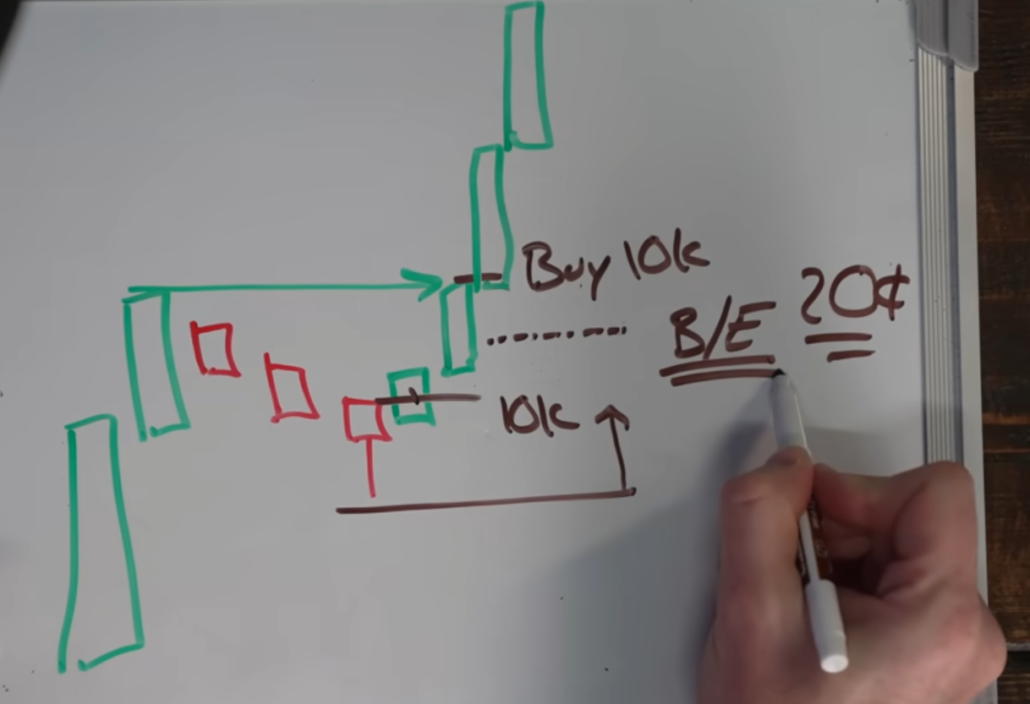
The psychological framing here is important: after adding, the position is often mentally processed as “risking house money,” even though the real risk is the unrealized profit being put back at risk. The reward is that a move of another 10 to 20 cents on the doubled position can turn a base hit into a much larger gain.
Practical Tools and Resources Ross Provides
Ross mentions free and paid resources available for those wanting to go deeper.
10.1 Free PDFs (Linked Under the Video)
He offers a set of downloadable PDFs:
- Trading Plan
- His written trading plan you can print and adapt.
- He strongly recommends practicing any plan in a simulator before trading with real money.
- Stock Selection Criteria
- The filter set he uses to narrow 10,000+ stocks down to 3–5 tradable names a day (essentially the criteria described above).
- Small Account Strategy Worksheet
- A structured worksheet on how he has grown small accounts multiple times.
- Described as a “tried‑and‑true system” for small account growth.
Links are pinned in the top YouTube comments and video description.
10.2 Platform and Data
- He uses Day Trade Dash for:
- Real‑time scanning.
- Charts.
- Hotkeys and trade execution.