

Basic concept: The shorter timeframe will always follow the longer timeframe
| Timeframe | Purpose | What to Identify |
| 1-Hour Chart | Market Direction | Overall trend, major shifts, bias |
| 5-Minute Chart | Trade Location | Key zones, previous day high/low |
| 1-Minute Chart | Execution | Precise entry point, risk minimization |
Step-by-Step Execution Process
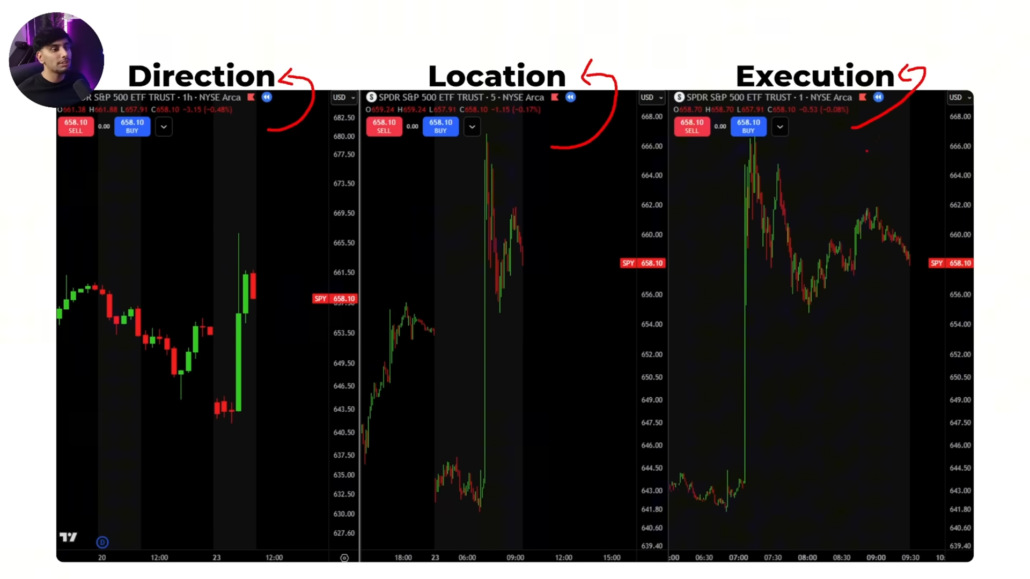
Step 1: Determine Market Direction (1-Hour Chart)
Objective: Establish your trading bias for the session.
- Open the 1-hour chart for your target asset
- Identify the current trend structure:
- Bullish bias: Price is breaking above previous higher highs + higher lows
- Bearish bias: Price is breaking below previous lower highs + lower lows
- Reversing: Breaking previous trend
- Neutral/Choppy: No clear directional structure — avoid trading
- Mark major support and resistance levels
- Note any significant momentum shifts or trend reversals
- Decision point: Only proceed if you have a clear directional bias, which may be contrarian or with the trend
Critical Rule: If the 1-hour chart shows no clear trend, do not trade. Wait for clarity.
Step 2: Identify Trade Location (5-Minute Chart)
Step 2 is about letting price come into an area that matters. Once the 1-hour chart has established direction, the 5-minute chart is used to identify the level where that directional idea has the highest chance of working.
The purpose of this step is not to predict every move. It is to isolate the few areas where buyers or sellers are most likely to act with conviction.
Objective
Use the 5-minute chart to identify a decision zone where price is likely to react in line with the 1-hour bias.
Do not take a trade simply because the market is moving. Only prepare for a trade when price reaches a level that can reasonably produce continuation or rejection.
What “Location” Means
A valid location is a price area where one or more of the following are present:
- Previous day high or previous day low.
- Clear support or resistance.
- Opening range high or low, especially the first 5-minute range.
- A breakout level that may be retested.
These levels matter because they often attract liquidity, cluster stop orders, and create the conditions for a real move. Areas without structure are usually low-quality and should be ignored.
Primary Locations to Mark
1. Previous Day High / Low
These are major reference points. Price is often drawn toward them, and once reached, the market typically has to make a decision.
Use them as potential continuation or rejection zones:
- If price breaks through and holds, continuation may follow.
- If price reaches the level and fails, rejection may follow.
2. Clear Support and Resistance
Mark zones where price previously reacted with strength.
Focus on:
- Areas where price reversed sharply.
- Areas where price consolidated before a strong move.
- Levels that have already acted as a barrier more than once.
These zones show where buyers or sellers were previously active. That makes them meaningful locations for future reactions.
3. First 5-Minute Range
The high and low of the first 5-minute candle after the market opens can define the initial battle area for the session.
Use this range as a reference for early momentum:
- A clean break may signal expansion.
- A failed break may signal rejection.
This is not automatically tradable on its own, but it becomes important when aligned with the 1-hour bias and a clear reaction.
Acceptable Reactions at Location
Reaching a key level is not enough. Price must also show a reaction worth trading.
There are two main reactions to look for:
A. Break and Retest
This is a continuation pattern.
Sequence:
- Price reaches a key level.
- Price breaks through it.
- Price returns to test that level.
- The level holds.
- Directional continuation becomes more likely.
Example:
- 1-hour bias is bullish.
- Price breaks above a major 5-minute level.
- Price retests and holds above it.
- The location is now valid for a long setup.
B. Rejection
This is a failure pattern.
Sequence:
- Price reaches a key level.
- Price attempts to continue through it.
- The move fails.
- Price quickly moves away from the level or cannot hold beyond it.
- Reversal or pullback becomes more likely.
Example:
- 1-hour bias is bearish.
- Price pushes into 5-minute resistance.
- Price is rejected and cannot hold above the level.
- The location is now valid for a short setup.
Rules for Step 2
Apply the following rules consistently:
- Start with the 1-hour bias already defined.
- Mark only obvious 5-minute levels.
- Wait for price to reach one of those levels.
- Do not enter in the middle of open space.
- Do not chase price after an impulsive move.
- Require either a break-and-retest or a clear rejection.
- Move to Step 3 only after location and reaction are confirmed.
Common Errors
The most frequent mistakes at this stage are execution errors caused by impatience.
Avoid the following:
- Entering far away from any important level.
- Chasing after price has already expanded.
- Forcing trades in the middle of a range.
- Confusing random movement with a meaningful reaction.
- Dropping to the 1-minute chart before the 5-minute location is valid.
The main principle is simple: do not trade movement by itself. Trade price behavior at a level that matters.
Step 3: Execute Entry (1-Minute Chart)
Objective: Enter the trade with precision and minimal risk.
- Switch to the 1-minute chart
- Wait for price to reach your identified zone from Step 2
- Look for confirmation signals:
- For longs: Bullish engulfing candle, higher low formation, volume spike
- For shorts: Bearish engulfing candle, lower high formation, volume spike
- Set your stop loss just below/above the entry candle or zone boundary
- Enter the position
- Set your target based on the next liquidity level identified in Step 2
Critical Rule: Never enter on the 1-minute chart without confirming Steps 1 and 2 first.
Trade Setup Examples
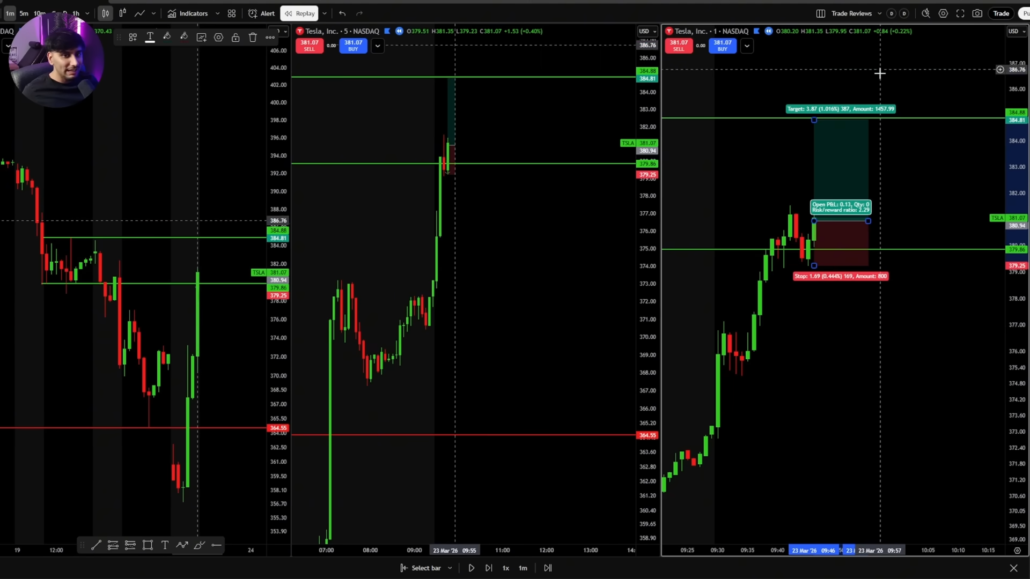
Example 1: Bullish Setup
- 1-Hour Check: Price breaks above previous lower high — bullish bias established
- 5-Minute Check: Price holds above previous day’s high (PDH) — bullish zone confirmed
- 1-Minute Entry: Price retests PDH, forms bullish engulfing candle — enter long
- Target: Next resistance level or liquidity zone identified on 5-minute chart
- Stop Loss: Below the PDH or entry candle low
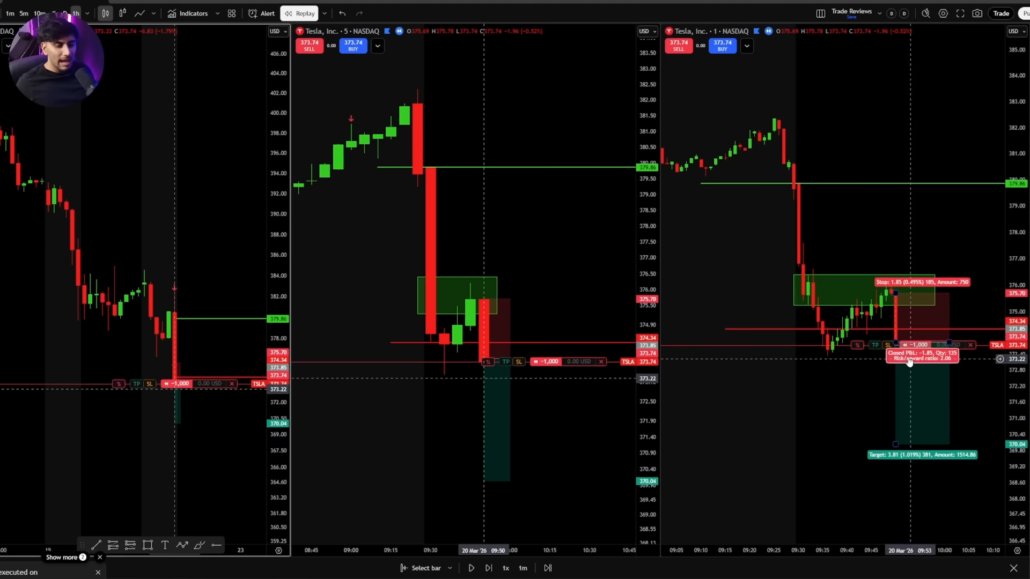
Example 2: Bearish Setup
- 1-Hour Check: Price breaks below previous higher low — bearish bias established
- 5-Minute Check: Price holds below previous day’s low (PDL) — bearish zone confirmed
- 1-Minute Entry: Price retests PDL resistance, forms bearish rejection — enter short
- Target: Next support level or liquidity zone identified on 5-minute chart
- Stop Loss: Above the PDL or entry candle high
Pre-Trade Checklist
Before entering any trade, verify all conditions are met:
- 1-hour chart shows clear directional bias (not choppy)
- 5-minute chart identifies specific trade zone (PDH/PDL or key level)
- 5-minute structure aligns with 1-hour bias
- 1-minute chart shows confirmation signal at the zone
- Stop loss placement is logical and acceptable risk
- Target is identified based on next liquidity level
- Risk-to-reward ratio is favorable (minimum 1:2)
If any checkbox is unchecked, DO NOT TAKE THE TRADE.
Common Mistakes to Avoid
- Trading against the 1-hour trend — This is the #1 cause of losses. Always respect the higher timeframe.
- Skipping the 5-minute confirmation — Entering directly from the 1-minute chart without verifying the zone leads to poor trade location.
- Forcing trades in choppy conditions — If the 1-hour chart lacks clear direction, wait for clarity.
- Ignoring previous day high/low — PDH and PDL are critical reference points that institutional traders watch.
- Moving stop losses during the trade — Set your stop based on structure and honor it.
Risk Management Guidelines
- Maximum risk per trade: 1-2% of total account balance
- Use tight stops on the 1-minute chart to minimize risk
- Scale out at targets: Take 50% at first target, let remainder run
- If the trade moves against you immediately, exit — setup was invalid
- Track your win rate and adjust if below 50% (likely skipping steps)
Daily Routine
Pre-Market (Before Market Open)
- Review overnight price action on 1-hour charts
- Mark previous day’s high and low on all watchlist assets
- Identify potential bias for each asset (bullish/bearish/neutral)
- Note major news events that could impact volatility
During Market Hours
- Monitor 1-hour charts for trend shifts
- When bias is clear, drop to 5-minute to find zones
- When price reaches zone, drop to 1-minute for execution
- Take trades only when all three timeframes align
- Log each trade with screenshots of all three timeframes
Post-Market Review
- Review all trades taken during the session
- Verify you followed the three-step process for each trade
- Identify any trades where you skipped steps — note the outcome
- Calculate daily win rate and profit/loss
- Adjust watchlist for tomorrow based on which assets showed clean setups
Key Principles to Remember
- Patience over action: Wait for all three timeframes to align. No alignment = no trade.
- Direction beats precision: A mediocre entry in the right direction (1-hour bias) beats a perfect entry against the trend.
- Zone awareness: The 5-minute chart tells you WHERE to trade, not just WHAT direction.
- Execution is last: The 1-minute chart is only for execution, never for determining bias or location.
- Discipline equals profits: Following this SOP consistently produces results. Skipping steps produces losses.
Appendix: Quick Reference Card
The Three Questions to Ask Before Every Trade:
- What is the 1-hour trend? (Determines if I trade long, short, or not at all)
- Where is the 5-minute zone? (Determines the specific level I’m watching)
- Does the 1-minute show confirmation? (Determines my exact entry point)
If you can’t answer all three questions clearly, you don’t have a trade.

